Guides
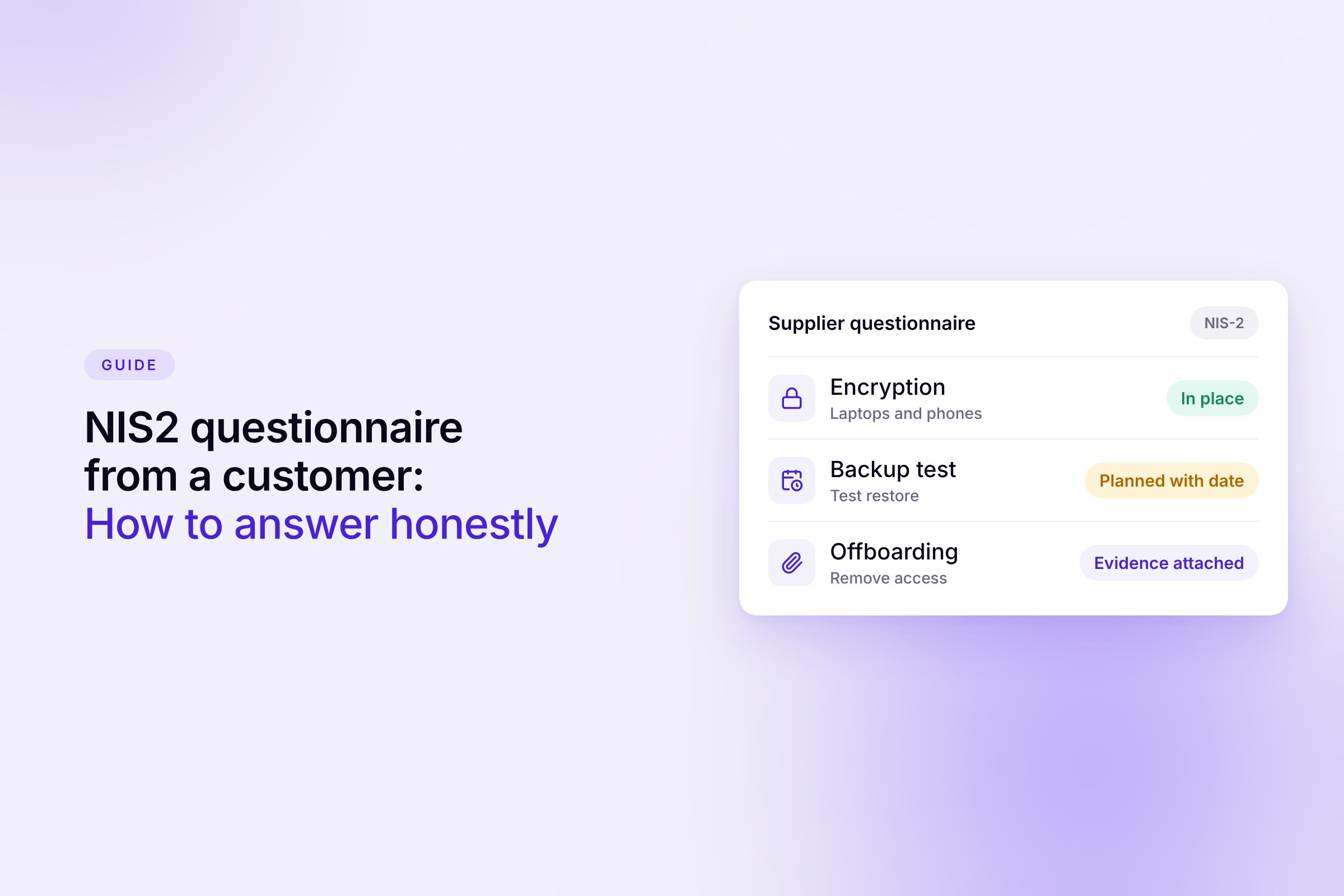

Germany's NIS-2 implementation act has been in force since December 2025. Most small and mid-sized companies are not covered by it directly, yet they still feel it when a customer sends over an information security questionnaire. It usually comes with a deadline and a request for evidence.
This guide covers the questions in almost every NIS2 supplier questionnaire and the evidence for each answer. It also shows how to handle points you don't meet yet.
Key takeaways
The act has applied since December 6, 2025, to companies in certain sectors above a certain size. In most of these sectors, the threshold is 50 employees or annual revenue and a balance sheet total of more than 10 million euros each. Companies in scope had to register with the BSI, Germany's Federal Office for Information Security, by March 6, 2026. The BSI tolerated late registrations until the end of July 2026.
These companies also have to manage the security of their supply chain. In practice, they do that through contracts and questionnaires sent to service providers and suppliers. In its NIS-2 FAQ (in German), the BSI states explicitly that the act can therefore have an indirect effect on companies that are not covered themselves.
How far the requirements for these suppliers should go is still an open question. In August 2026, TeleTrusT, the German IT Security Association, put exactly this question to the BSI. It asked whether questionnaires and evidence are enough for a small supplier, or whether documented measures are needed. As of November 20, 2026, we have not found a published answer from the BSI. Until there is one, each customer decides what is enough for them.
Legally, then, the questionnaire does not commit you to anything at first. It becomes binding once answers or security requirements make it into a contract. For what the BSI generally expects for accounts and devices, see our guide to BSI requirements for devices and access.
Once you have 50 employees or more, take a second look. Besides energy, healthcare and transportation, the regulated sectors include digital infrastructure. That covers cloud providers and IT service providers that run systems for other companies as managed service providers. The BSI's NIS-2 scope check (in German) tells you whether that includes you. If it does, you have obligations of your own that go far beyond a questionnaire.
Questionnaires differ from customer to customer, but the topics are very similar. They usually follow the measures the act requires of companies in scope, from access control and encryption to multi-factor authentication. Nine topics come up almost every time.
Be especially careful with your answers on access and offboarding. They go straight to the question of who can reach your customer's data, including after someone leaves. Our guide to deprovisioning explains why locking the Google or Microsoft account is not enough on its own.
With the device inventory, the problem is usually keeping it current. A list exists, but it is out of date. Our IT inventory software comparison shows which tools keep an inventory up to date on their own.
A questionnaire is not a test you pass by checking as many boxes as possible. Your customer has to assess their supply chain and needs a realistic picture to do that. Every answer falls into one of three categories.
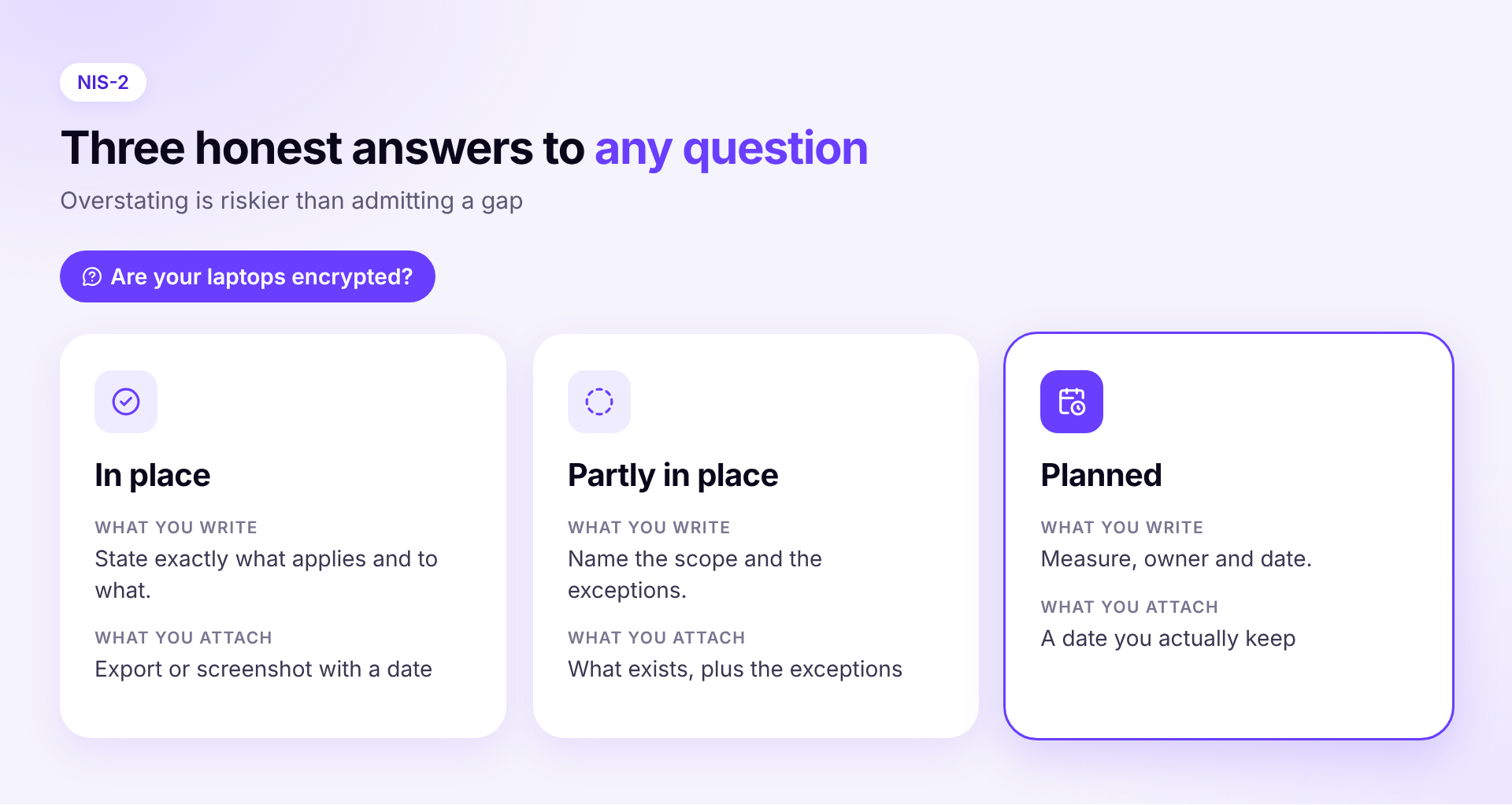
Be specific, not sweeping. A plain yes says little. Add what exactly applies and where you check it. For example, “All company laptops are encrypted with FileVault or BitLocker. We see the status centrally for every device.”
Only commit to what you can show. If you write “all devices” today and the next audit turns up unencrypted laptops, you are worse off than with an honest limitation. That matters even more when your answers end up attached to the contract.
State the scope. Say what an answer covers, such as all company laptops or all accounts in Google Workspace. That prevents misunderstandings and protects you from commitments that are broader than you meant.
Keep evidence ready, but don't send everything. An export of the device list or a dated offboarding record makes good evidence. Share internal documents such as network diagrams only when it is really necessary and a nondisclosure agreement is in place.
Also keep your answers and evidence in one place. The questions repeat from customer to customer, so you won't start from scratch with the next questionnaire.
A gap is no reason to skip a question or gloss over it. Write down what applies today, what you are changing, who is responsible and by when. For example, “A restore test of our backups has not been documented so far. We will run the first test by the end of January and repeat it every six months after that. Management is responsible.”
Some gaps take less time to close than the questionnaire takes to fill out. Multi-factor authentication can be enforced centrally for all accounts in Google Workspace and Microsoft 365. Disk encryption is already built into macOS and Windows. A reporting process for security incidents fits on a single page.
A tested backup, an emergency plan and fixed processes for people joining and leaving take longer. What counts here is giving a realistic date and then sticking to it.
It still has to fit your size. Even for companies in scope, the act only requires measures that are proportionate to their size and risk. For smaller companies, especially those under 50 employees, the BSI offers the CyberRisikoCheck (in German) based on DIN SPEC 27076. A trained IT service provider checks 27 requirements in a one- to two-hour interview. You then get a report with recommendations sorted by urgency. It is not a certification, but it is an honest assessment of where you stand that you can show a customer.
How Sovaro helps
Sovaro shows every company laptop with its employee and checks nine security rules on each device. These include encryption, firewall and current updates. You also see who uses which tools. Offboarding runs as a process with tasks for the tool admins. Every change lands in the audit log, with export. So the evidence for inventory, encryption, updates and access removal builds up along the way. It does not replace a certification. Try it for free
Not by law. Your customer can make the business relationship depend on it, though. And whatever ends up in the contract is binding.
A no does not automatically end the relationship. What matters is that you explain the gap and name a measure with a date. Some customers do make individual points such as MFA a condition, though.
The act does not require it of suppliers. Some customers ask for it anyway. For smaller companies, the BSI's CyberRisikoCheck is an easier place to start.
Your contract determines that. Companies in scope have to send the BSI an early warning within 24 hours of a significant incident themselves. That is why they expect quick information from their suppliers as well.